
Bee County Release Records Explained
A Bee County jail release is a completed custody event. The strongest local proof is the Sheriff's release report with its booking number, release date and time, terminal code, releasing authority, and transfer destination. A person normally drops out of a live jail lookup after that event. Disappearance alone is weaker because it can also reflect a transfer, hospital movement, or data interruption.
The agency owning the event controls the useful record. The Bee County Sheriff's Office and Jail documents a county-jail exit. A court can show the bond order, dismissal, judgment, sentence, or community-supervision order that allowed custody to end. TDCJ documents a prison release or discharge. BOP, USMS, and ICE have separate roles in federal and immigration custody.
Ways Bee County Custody Ends
The release code must be read with court and destination fields. “Released” does not always mean the person entered the community, and a court order does not prove jail staff completed the exit at that moment.
| Event | Meaning | Next verification point |
|---|---|---|
| Bond or personal bond | The court authorized release while the case continues. | Jail timestamp and bond order |
| Dismissal or time served | A charge ended or required county time was credited. | Release report and docket |
| Probation | The court ordered community supervision. | Sentencing court and local CSCD |
| TDCJ transfer | County custody ended but confinement continued. | TDCJ Inmate Search |
| Parole or mandatory supervision | A state prisoner left institutional custody under supervision. | TDCJ IVSS and Parole Division |
| Federal or ICE handoff | Another authority may have taken custody. | Federal docket, USMS, BOP, or ICE |
Note: A receiving-agency entry can matter more than a generic release label when deciding whether someone entered the community.
Fields in a Bee County Release Record
A useful record ties the exit to one booking and defines the terminal code. Names alone can collide, so compare date of birth, aliases, booking number, and case number before joining jail and court records.
| Field | What it shows |
|---|---|
| Booking number | Connects arrest, custody, charges, bonds, and release. |
| Admission and release times | Marks the recorded start and end of the jail stay. |
| Release type or code | States the basis, read with the agency's definition. |
| Releasing authority | Identifies the court or agency supporting the exit. |
| Charges and bonds | Shows the case context attached to the booking. |
| Destination or transfer | May identify TDCJ, another county, USMS, or ICE. |
| Booking photograph | May be requested if public and reasonably separable. |
A court disposition answers another question. “Disposed” means the court reached an outcome, not that jail staff released the person that day. A certified disposition is stronger proof of case outcome; the Sheriff's timestamp is stronger proof of physical departure.
Request Bee County Release Records
The Sheriff page does not publish a dedicated public-information email or form. Call the Bee County Sheriff's Office first to confirm its currently designated delivery method before sending a written Texas Public Information Act request.
- Identify one booking. Give the full name, date of birth if known, booking number, and approximate custody dates.
- Name existing records. Ask for the booking sheet and release report, including timestamps, release code and definition, authority, bonds, and destination.
- Address the photo. Request the booking photograph if public and reasonably separable while accepting lawful redaction.
- Set delivery and cost terms. Ask for electronic copies and notice before charges exceed a stated limit.
- Match the answer. Compare it with the proper clerk, court, TDCJ, or receiving-agency record.
1509 Galloway Drive, Beeville, TX 78102
361-362-3221
Call before an in-person records visit.
Government Code §552.221 calls for prompt production as soon as reasonably possible. Ten business days is not a universal production deadline; that period generally concerns an agency request for an Attorney General ruling under §552.301. An estimate above $40 triggers an itemized estimate and less-costly alternatives under §552.2615.
Texas Rules for Bee Release Records
Government Code Chapter 552 covers public information, including electronic information and photographs, subject to exceptions and other confidentiality laws. Section 552.108 can protect specified law-enforcement information, while §552.108(c) preserves access to basic information about an arrested person, arrest, or crime. Juvenile, medical, sealed, expunged, security, and protected identifying material can be withheld or redacted.
Which Bee County Court Proves a Release?
The County Clerk handles county criminal records, the District Clerk handles felony district-court matters, and the Multi-County Court at Law is another local custodian. Search the exact person and case, then inspect orders rather than relying on a result label.
The County Clerk lists a $10 criminal name search, $1 per copy page, and $5 certification per instrument. Confirm charges before ordering. Its portal's “Last 24 Hours” and “Last 3 Days” filters concern recorded documents, not inmate releases. If the District Clerk's older online route fails, call 361-621-1562.
Does “bond posted” prove release? No. Another hold may keep the person confined. Pair the order with the jail's terminal event.
How Expunction Changes Bee County Release Searches
Texas expunction is governed principally by Code of Criminal Procedure Chapter 55A. Eligibility is fact-specific. Bee County's official distribution list names the Sheriff, Beeville police, prosecutors, courts, clerks, DPS, and TDCJ while warning the list may not be complete. That map explains why lawful expunction can change later searchability across many systems.
Nondisclosure under Government Code Chapter 411 is different. It generally restricts public disclosure of qualifying criminal-history information without destroying the record and allows access by listed entities. A missing result after a lawful order is not proof the custody never occurred, and protected records should not be reconstructed from mirrors.
Why Bee County Jail History Affects Release Records
An official county budget says the Bee County jail opened January 1, 1989, at a reported original cost of $2,905,359. It also says the jail historically housed federal, state, and other counties' prisoners when space was available. Those facts explain an enduring records problem: the building where a person slept does not always identify the government authority that controlled the case or the next movement.
The boarding description is historical, not proof of any present contract. A current search must still identify the specific booking authority and terminal destination. If the Sheriff's release transaction names another county, TDCJ, USMS, or ICE, continue with that custodian. If it records community release, pair the timestamp with the court event that supplied authority.
Find a Released Bee County Inmate
Start with the last verified custodian, not a broad name search. The path changes when a county detainee transfers to TDCJ or another authority controls the next event.
- Confirm identity. Collect the name, aliases, birth date, booking or case number, and approximate dates.
- Check county status. Open Texas IVSS Counties, select Bee County, and compare the person and facility.
- Ask the jail. Call 361-362-3221 or request the release transaction, terminal code, and receiving agency.
- Read the court event. Find the bond, dismissal, judgment, sentence, probation, revocation, warrant, or discharge entry.
- Follow a transfer. Use TDCJ for state custody, federal court and BOP or USMS for federal custody, and ICE ODLS when indicated.
- Obtain durable proof. Request the release report, certified disposition, or agency history instead of saving only a live screen.
TDCJ Search After a Bee Release
TDCJ Online Inmate Search is chiefly a current-inmate locator. It helps after a Bee County Jail transfer into state custody. A fully discharged person may no longer appear, so use TDCJ IVSS, information channels, or a formal request for history.
| Input or field | Use |
|---|---|
| Name | Starts a search; compare more identifiers. |
| TDCJ number or SID | Narrows the state record. |
| Gender and race | Optional same-name filters. |
| Projected release | A changeable estimate. |
| Parole eligibility | A review threshold, not a promise. |
| Maximum sentence date | The current endpoint calculation. |
The official TDCJ search screen shows the current state-inmate search inputs:
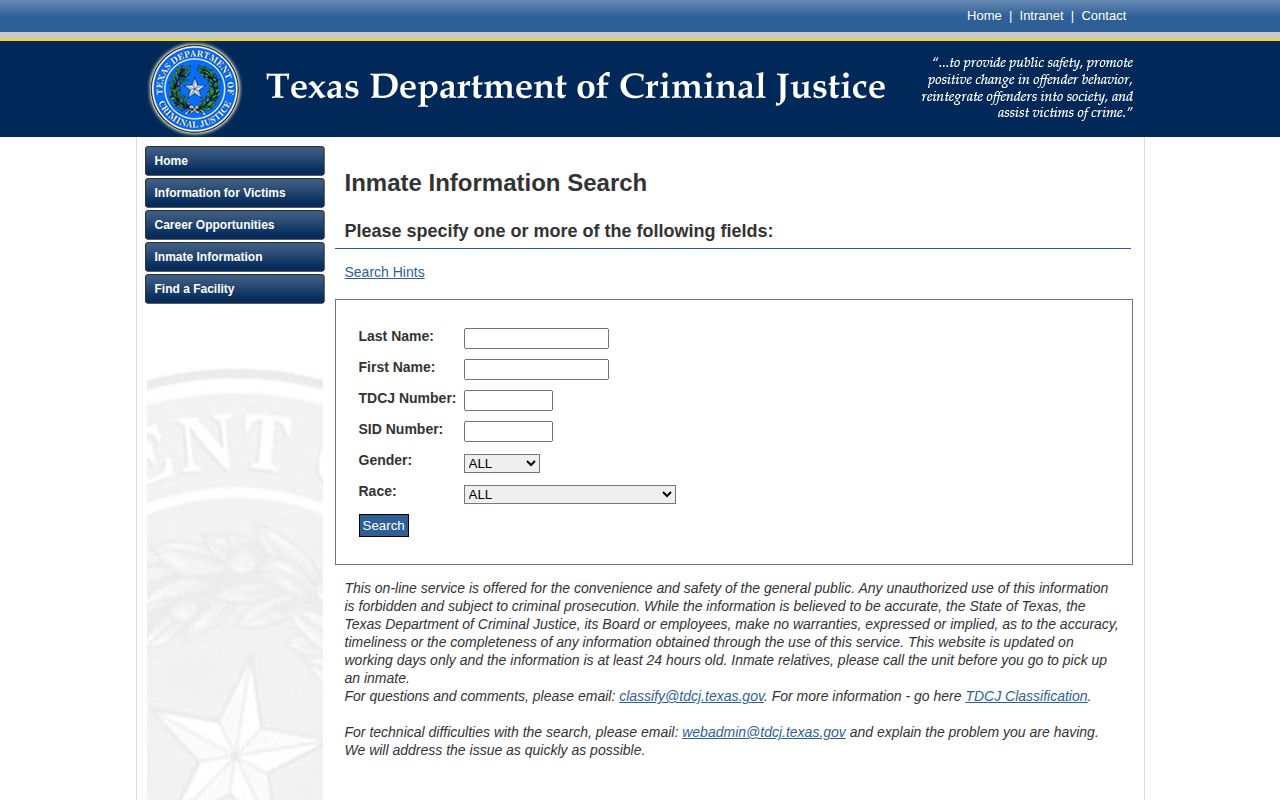
The captured form reinforces the identifier-first search path. After release, TDCJ IVSS and agency records better document parole, mandatory supervision, or discharge.
Bee County Recent Release Lookup
The Sheriff links IVSS Counties but offers no official roster, photo gallery, or rolling 24-hour or 72-hour release list. IVSS is a named-person status and notification service, not a historical ledger. It warns former detainees may be absent and its display is not an official record.
Ask for existing release transactions between exact timestamps. The Jail Releases: 24 Hours guide explains that same-day request and verification chain.
Where Bee County Parolees Report After Release
TDCJ Parole Division supervises parole and mandatory supervision after prison. Probation is imposed by a court and administered through the local Community Supervision and Corrections Department. A TDCJ parole search does not verify probation, and an old probation order does not prove that supervision remains active after a later completion, revocation, or discharge.
Bee County maps to the Corpus Christi District Parole Office and Day Reporting Center at 422 Sunbelt Drive, Corpus Christi, TX 78408, 361-888-5698. The Day Reporting Center serves Bee and six neighboring counties. This is the local state-supervision layer for released parolees. The Beeville Institutional Parole Office, despite its local name and address, prepares institutional cases for incarcerated people and is not the ordinary reporting office for a person already released.
Verify identity with a TDCJ or SID number, check TDCJ IVSS for parole or mandatory-supervision status, and then use the proper status line or field office for public questions. A warrant or absconder flag alleges noncompliance and may lead back to custody, but it does not erase the earlier institutional release.
Bee County Release Alerts Across Custody Systems
Texas moved county notification to IVSS Counties on September 1, 2025. Follow current account and contact-verification prompts, not legacy VINE PIN steps. TDCJ runs a separate IVSS for prison and state supervision, and a county subscription should not be assumed to follow a state transfer.
The county portal permits a status search by full or partial name and identifiers such as DOC ID, SID, Jail ID, or permanent booking number. Select the exact Bee County person, read the displayed change, and use the current registration prompts. Support is available at 866-268-8959 around the clock. The portal warns its display is not an official record, so save the event details and confirm them with the Sheriff.
TDCJ IVSS covers state prison, parole, and mandatory supervision. Search by name, SID, or current or previous TDCJ number, open View Details, compare facility and dates, and subscribe to the exact person. County and state registrations are separate because their contributing agencies and custody scopes differ.
Was a Bee County Release an ICE Transfer?
The county's historical federal boarding does not establish a current ICE contract, dedicated immigration facility, active USMS agreement, or 287(g) program. An immigration detainer is a request to notify ICE and allow a possible handoff when local authority would otherwise end. It does not prove ICE accepted custody. Start with the Sheriff's destination or receiving-agency field.
If that field names ICE, search ICE ODLS with a nine-digit A-number and country of birth, or with exact name, date of birth, and country of birth. Minors are excluded, some people do not appear, and updates may lag. A missing result cannot prove community release. Contact the relevant ERO office when the county record shows an immigration handoff that ODLS does not resolve.
The BOP locator is different. It can show a past date and “RELEASED” for Bureau custody after 1982, meaning only that BOP custody ended. USMS has no comparable public locator for every pretrial detainee. Use the federal docket for detention and release orders and a defined USMS records request for the transport or custody event.
Bee Release or Custody: Choose a Record
Each system answers a limited question. Match the source to the custodian and distinguish present location from historical proof.
| System | Still in custody | Released-person value |
|---|---|---|
| Bee IVSS | Local status lead | Change lead; confirm with jail |
| Sheriff release report | Not a locator | Primary local time, type, destination |
| Bee court | Orders and warrants | Legal basis, not exact exit alone |
| TDCJ Search | Current state detail | Limited after discharge |
| BOP locator | Federal Bureau status | Exit from BOP only |
| ICE ODLS | Current or recent ICE detail | No result is inconclusive |
Bee County Release Facilities
The six mapped channels cover local arrest, county booking, state confinement, and possible federal or immigration movement. Each line needs a different release record.
- Bee County Sheriff's Office and Jail: local booking, community release, or transfer confirmed by the Sheriff.
- Garza West Unit (NH): TDCJ intake, receiving, transient custody, and state transfer or release records.
- Garza East Unit (NI): a live TDCJ directory entry whose current operating role should be confirmed directly.
- William G. McConnell Unit (ML): a TDCJ prison and Regional Release Site using state release records.
- Beeville Police Department holding/booking channel: municipal arrest records followed by the county custody event.
- Federal/USMS contract bed, if used: no standalone local facility confirmed; follow BOP, USMS, federal court, or ICE authority.
Use the facility name to identify the custodian, not to assume the outcome. A Bee County Jail exit may lead into a state unit, and a movement out of Garza West may be an internal TDCJ transfer. Current operating questions about Garza East should go to TDCJ rather than a private directory.
Why TDCJ Releases Occur in Bee County
Bee County contains several TDCJ directory facilities, and McConnell is expressly listed as a Regional Release Site. A person convicted in another Texas county may physically leave state custody through McConnell. A Bee County resident may be processed for release somewhere else. Geography does not transfer ownership of the record from TDCJ to the Bee County Sheriff.
Garza West has intake, receiving, and transient functions, so departure there often means transfer within TDCJ rather than release. McConnell's regional operation makes an actual state release locally possible. Garza East remains in the official directory, but its present role should be confirmed before making a time-sensitive claim.
For any of these state facilities, use the TDCJ number across units. Before release, compare projected release, parole eligibility, maximum sentence, and any scheduled location. Afterward, use TDCJ IVSS, Review and Release Processing, or a TDCJ incarceration history or release certificate. Do not ask the county jail to certify a prison discharge merely because the physical exit occurred in Bee County.