
Bee County Parole Versus Probation
Parole follows release from a TDCJ prison sentence. The Texas Board of Pardons and Paroles decides whether parole is approved, while the TDCJ Parole Division handles release processing and field supervision. Mandatory supervision is another state release route with its own eligibility and approval rules. Neither is the same as full discharge.
Probation, called community supervision in Texas law and court records, is imposed by a judge. It may let a person serve a sentence in the community instead of prison, or it may follow a county case disposition. The Bee County sentencing court and Community Supervision and Corrections Department, known as the CSCD, are the relevant custodians. A TDCJ parole search does not verify probation.
| Point | Parole | Probation |
|---|---|---|
| Authority | Board decision after a prison sentence | Court order in the criminal case |
| Supervising agency | TDCJ Parole Division | Local CSCD |
| Core record | TDCJ status, certificate, and parole file | Judgment, supervision order, and CSCD record |
| End event | Parole discharge or sentence completion | Court or CSCD completion or discharge |
Verify Bee County Post-Release Supervision
Start with the custody system that preceded release. A TDCJ number or state-prison history points toward parole or mandatory supervision. A Bee County judgment that orders community supervision points toward probation. Do not infer the type merely because the person is living in the community.
- Confirm identity with full name, date of birth, case number, TDCJ number, or SID.
- For a state case, search TDCJ IVSS and review offender status, release date, and supervision events.
- For probation, obtain the Bee County judgment and later docket entries from the court that imposed the order.
- Contact the correct field office or CSCD for public status details and routing.
- Look for a completion, revocation, warrant, or discharge event before describing supervision as current.
The TDCJ current-inmate locator may show dates before release, but it is not a discharged-person archive. IVSS and official records are better for the post-release state path. A court’s old probation order also needs later entries because completion or revocation may have changed it.
Bee County Parole Review Records
The Board of Pardons and Paroles does not conduct a public formal hearing for ordinary parole consideration. Members review a file and vote in sequence. TDCJ generally identifies a case months before eligibility, and an institutional parole officer prepares a summary. Two matching votes on a three-member panel decide the result.
The official BPP review explanation shows the review cadence and panel process captured below. It helps interpret a pending or completed vote without treating review as release.
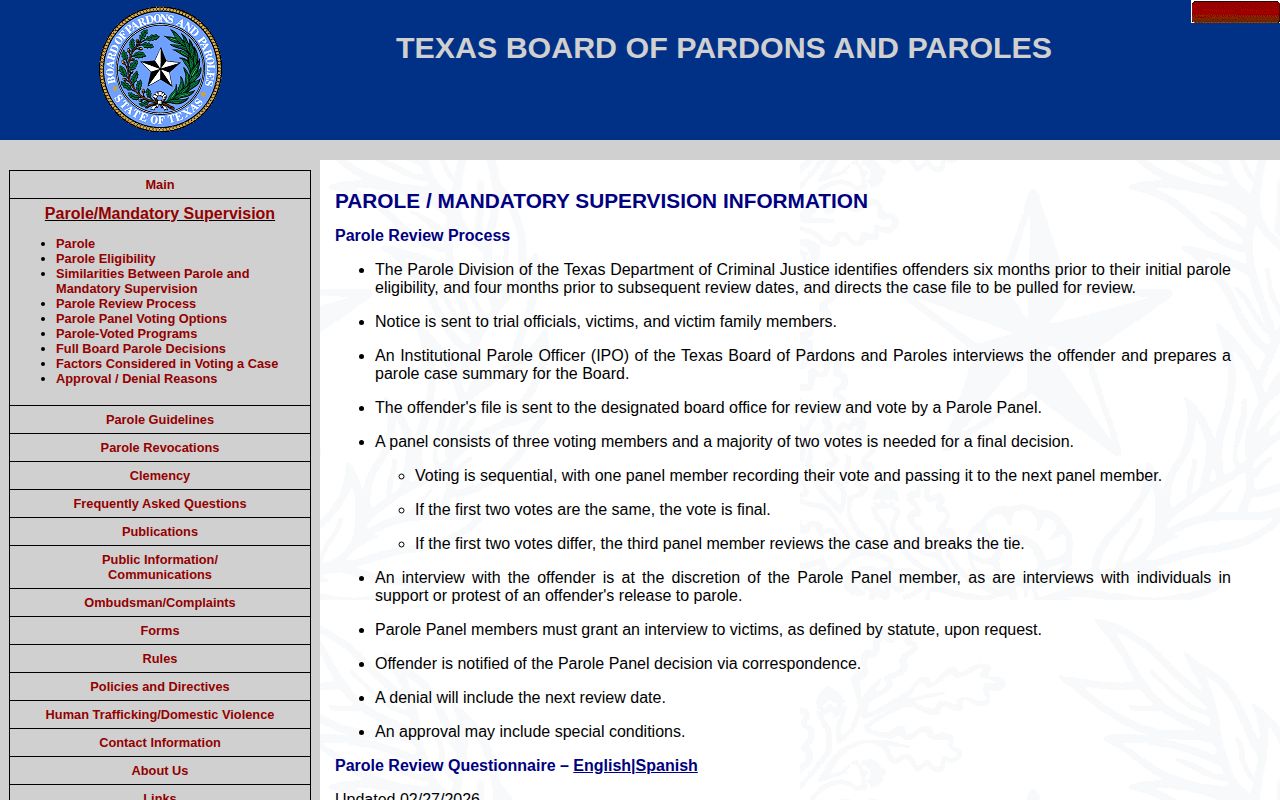
The panel process can yield approval codes tied to eligibility, a future month, or program steps. A favorable code still requires TDCJ release processing. Call 844-512-0461 for pre-vote status and 512-406-5202 after approval. Physical release must be verified separately.
Corpus Christi Bee Parole Office
Bee County does not have a separate TDCJ district parole office listed in the state county routing directory. The TDCJ county-to-office directory maps Bee County to the Corpus Christi District Parole Office. That is the field-supervision route for released parolees.
Corpus Christi District Parole Office and Day Reporting Center422 Sunbelt Drive
Corpus Christi, TX 78408
361-888-5698
Fax: 361-906-3311
This address is for the state parole path, not probation. A person on Bee County court-ordered community supervision belongs with the local CSCD and sentencing court. Confirm the case and supervision type before contacting either office.
Beeville Office Is Institutional
The Beeville Institutional Parole Office can look like the closest option because of its local name and address. Its role is different. An institutional parole office prepares and handles cases for people who are still incarcerated. It is not the ordinary reporting office for a released Bee County parolee.
TDCJ lists the institutional office at 2033 Independence Street, Building 2189, with phone 361-362-6511. Use it only for an institutional-case question that belongs there. Route released-person field supervision to Corpus Christi. This local distinction prevents missed contacts and keeps a prison review question separate from community supervision.
Distance and city name do not establish jurisdiction. The state directory’s function label and county assignment control.
Bee County Day Reporting Support
The Corpus Christi Day Reporting Center expressly serves Bee County along with six neighboring counties. This is Bee County’s local layer for structured state post-release supervision services, even though the center is outside Beeville.
A day reporting center may support case management, reporting, and services within a person’s supervision plan. Its presence does not mean every parolee is assigned there. It also does not prove a person’s release. The individual certificate, status, officer assignment, and conditions decide what applies.
The distinction matters because the Beeville institutional office serves incarcerated cases. The Corpus Christi DPO and DRC serve the released-person state supervision route. Probation still remains with the court and CSCD.
Bee County Warrants and Absconders
A supervision warrant means an authority alleges noncompliance and seeks custody. An absconder is a person the supervising agency reports as having stopped required contact or left supervision without authorization. Neither label erases the earlier release from institutional custody.
TDCJ maintains a Sex Offender Absconder Information Search, but it covers only that defined population. It is not a general parolee lookup. A missing result there cannot confirm good standing, discharge, or the absence of another warrant.
For parole, check IVSS and contact the field office within public-information limits. For probation, review the Bee County docket for revocation motions, capias or warrant entries, and later court orders. A capias is a court command to take a person into custody. Match the exact person and case because names alone can mislead.
Bee County Supervision Conditions
Conditions are the enforceable rules attached to release or community supervision. They can include reporting, approved residence or travel, program participation, fees, and case-specific restrictions. The actual certificate or court order controls. General descriptions cannot establish a named person’s terms.
A violation allegation may lead to investigation, a warrant, a hearing or court proceeding, changed conditions, or return to custody. The outcome is not automatic. TDCJ handles parole matters under the state process, while the sentencing court controls probation revocation. Read the later decision rather than stopping at an allegation.
- Parole
- Conditional release from prison under TDCJ supervision.
- Probation
- Court-ordered community supervision administered locally.
- Absconder
- A person alleged to have stopped required supervision contact.
- Revocation
- A formal decision ending supervision and imposing the authorized custody result.
- Discharge
- The official end of the supervision obligation.
Bee County Supervision Discharge
Release and discharge are separate events. A parolee has left prison but remains under state authority until the applicable discharge. A person on probation remains bound by the court order until completion, early termination, revocation, or another final action is recorded.
For parole, request TDCJ status or history and look for the discharge event. For probation, obtain the later Bee County docket and completion or discharge record from the sentencing court or CSCD. Do not rely on an old end date alone because tolling, warrants, revocation proceedings, or modified orders can affect the record.
Bee County court routing depends on the case. The County Clerk handles county criminal matters, while the District Clerk serves felony district-court records. Bee County also has a Multi-County Court at Law. Search by exact name and case number, then inspect the actual judgment and later docket entries for community supervision, revocation, completion, or discharge. A docket marked disposed only means the court reached a case outcome. It does not establish that probation ended on that date or that a separate hold disappeared.
If an online district-court link fails, use the current county government page and call the District Clerk at 361-621-1562. For county criminal records, the County Clerk can be reached at 361-621-1557. The clerk record explains the court action, while the CSCD remains the custodian for supervision details that are public.
The Bee County released-inmate records path can help identify whether the last custodian was the county jail or TDCJ before supervision is checked. Once the route is known, use the state or court custodian that owns the final event.