
Bee County Projected Release Routes
The first task is identifying the custodian. Bee County Jail handles local pretrial detention and county sentences. TDCJ handles people committed to state prison, including those at Garza West, Garza East, or McConnell. Federal and immigration custody use separate systems. A date from one system cannot be applied to another.
A pretrial detainee usually has no fixed sentence-completion date. Release can depend on bond, a court order, dismissal, or resolution of holds. A sentenced county detainee’s date depends on the judgment, jail credit, and lawful local computation. A TDCJ prisoner can have projected, eligibility, maximum, and later scheduled fields. Each answers a distinct question.
| Custody | Date source | Best final proof |
|---|---|---|
| Bee County pretrial | Bond and court orders | Sheriff release transaction |
| Bee County sentence | Judgment, jail credit, jail computation | Jail release report |
| TDCJ prison | TDCJ offender detail and processing | TDCJ release certificate or history |
| Federal or ICE | Federal docket, BOP or ICE system | Owning agency record |
Find Bee County Projected Dates
For TDCJ, start with a TDCJ number or SID. The statewide current-inmate search also accepts an exact last name plus at least a first initial, with gender and race available to narrow results. Verify the person through number, conviction county, court, offense, and sentence before reading the dates.
- Identify whether Bee County Jail, TDCJ, BOP, or ICE currently controls custody.
- Gather the full name, date of birth, booking or TDCJ number, and case information.
- For TDCJ, open the matching offender detail and compare every date label.
- For Bee County Jail, read the court judgment and request the jail’s current computation.
- Check for parole action, warrants, detainers, new cases, or amended sentences.
- After the date passes, confirm the actual terminal event with the owning agency.
The official TDCJ search form shown below documents the fields used for a current state-prison lookup.
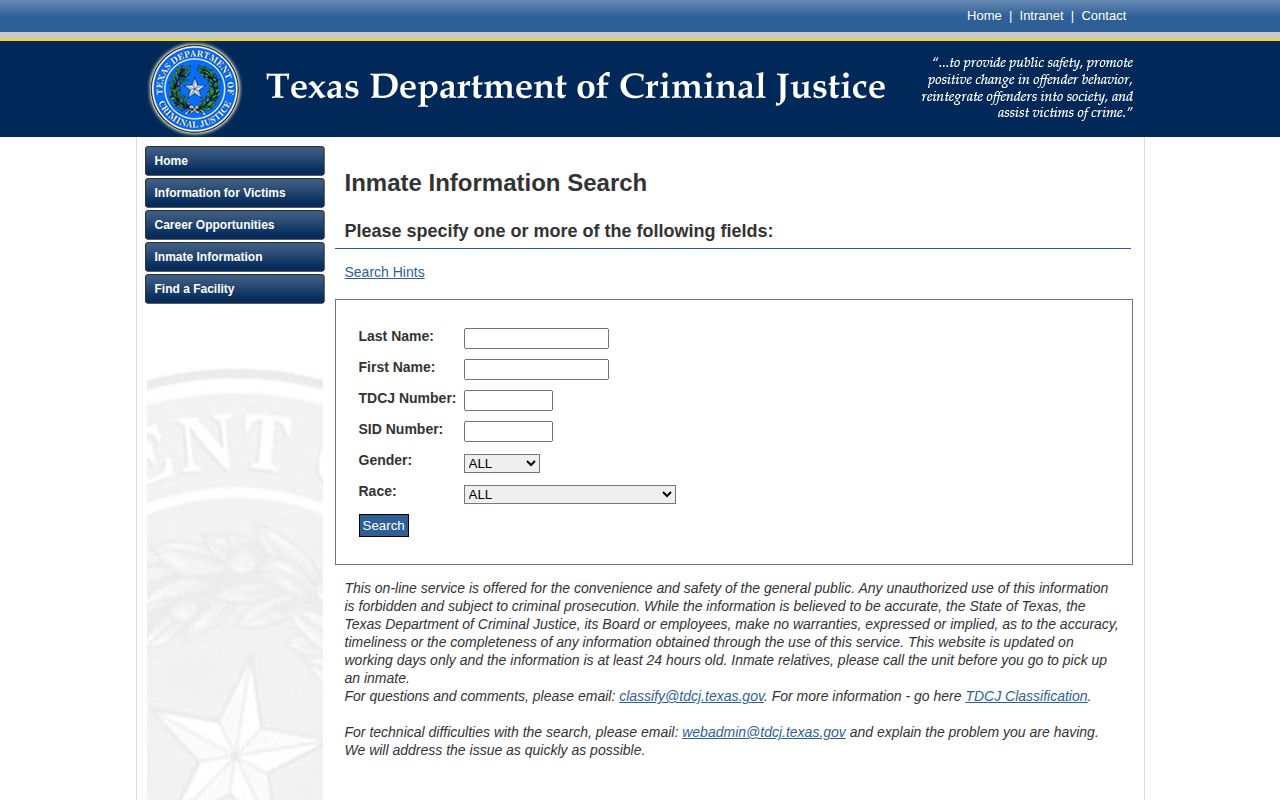
The search form applies to current TDCJ incarceration. It is not a Bee County Jail roster or a full archive of people who have discharged.
TDCJ Projected Release Definition
TDCJ defines projected release date as the date Classification and Records presently projects release from incarceration if the person is not paroled sooner. Offense title and offense date affect the calculation. The field is neither parole eligibility nor a guarantee that release will occur that day.
The official TDCJ inmate information page supplies the projected-release definition captured below. It also explains the email route for state information.
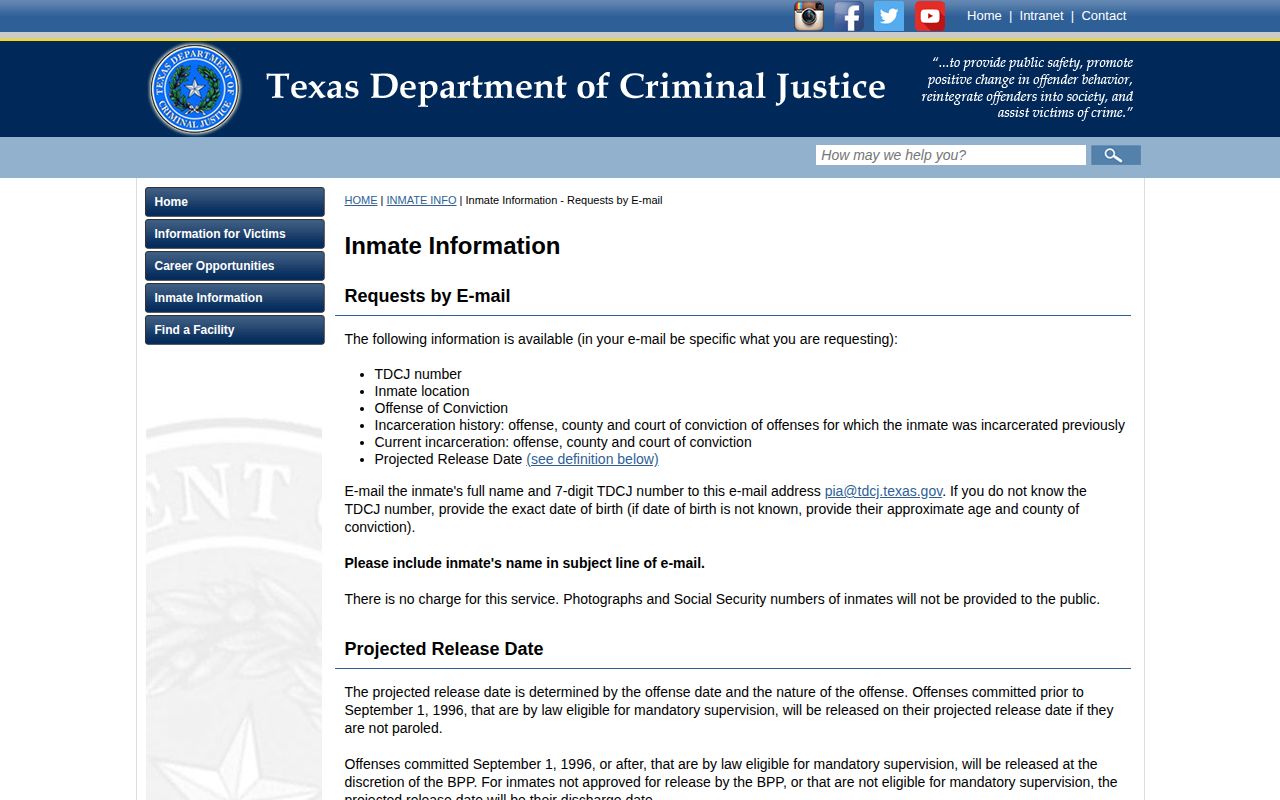
The definition frames the date as a present projection. A later Board decision, calculation audit, discipline event, program requirement, or hold can alter the displayed result.
- Projected release date
- TDCJ’s current calculation if parole does not occur first.
- Parole eligibility date
- The point when a qualifying case may be reviewed.
- Maximum sentence date
- The general full-term expiration field for the state sentence.
- Scheduled release date
- A planned date shown later in processing that may still change.
- Actual release date
- The completed event recorded by TDCJ.
Bee County Scheduled Versus Actual
A scheduled release date and location may appear after approval and release processing advance. That makes the field more specific than a projection, but it remains prospective. TDCJ warns that a scheduled date may change even close to the event.
Release processing reviews the sentence, applicable credits, conditions, warrants, detainers, plan, and program completion. Call Review and Release Processing at 512-406-5202 for a post-approval case. A Board status line at 844-512-0461 addresses pre-vote review, while general inmate information is available at 936-295-6371 or 800-535-0283 on weekdays from 8 a.m. to 5 p.m.
If the scheduled site is McConnell, the physical exit can occur in Bee County for a person convicted elsewhere. McConnell’s Regional Release Site role does not shift records custody from TDCJ to the Bee County Sheriff.
Texas Good Time Calculations
Texas Government Code Chapter 498 governs good-conduct classification, accrual, and forfeiture. Credits affect eligibility and calculation only as the controlling law allows. They are not vested proof of a release date. Disciplinary forfeiture or a corrected calculation can change a projection.
For mandatory-supervision-eligible offenses before September 1, 1996, TDCJ describes the projected date as the point when flat time plus good time equals the sentence, absent earlier parole. For eligible offenses on or after that date, the same credit calculation also requires Board approval under discretionary mandatory supervision. A denial can move the projection to maximum expiration, while later approval can move it earlier. Noneligible cases generally project to maximum expiration unless parole occurs sooner.
Flat time means actual calendar time served. Good-conduct time is a statutory credit used only as the law provides. Mandatory supervision is a form of supervised release, not a promise created by reaching a number on a calculator.
No Texas 85 Percent Rule
Texas has no universal rule requiring every prisoner to serve 85 percent of a sentence. Importing that phrase from another jurisdiction produces false Bee County release dates. The offense, offense date, sentence, and exact section of Texas law control.
Under Government Code Section 508.145, the general parole-eligibility framework uses actual calendar time plus good-conduct time equal to one-fourth of the sentence or 15 years, whichever is less, subject to the statute. For listed serious offenses, actual calendar time without good-time consideration must generally reach one-half of the sentence or 30 years, whichever is less, with offense-specific qualifications and minimums.
Eligibility only opens a review opportunity. It does not require the Board to approve parole, establish a scheduled date, or prove physical release. Sections 508.147 through 508.149 also affect mandatory supervision and exclusions.
Changes to Bee Release Dates
A displayed date is a snapshot of the facts and law then in the record. Some changes move it later, while others can move it earlier. The agency calculation, not a private formula, controls.
| Change | Possible effect | Where to verify |
|---|---|---|
| Disciplinary credit loss | Projection or eligibility may move | TDCJ classification record |
| Amended sentence or jail credit | Term calculation changes | Court judgment and agency audit |
| New case, warrant, or detainer | Release may be delayed or become transfer | Owning and receiving agencies |
| Board decision | Parole or mandatory path changes | BPP status and TDCJ processing |
| Program or plan completion | Scheduled processing can advance | Review and Release Processing |
| Calculation audit | Displayed dates can be corrected | TDCJ Classification and Records |
An additional hold can also change where the person goes without changing the fact that one sentence ended. Confirm whether the terminal event is community release or transfer.
Bee County Jail Date Limits
Do not apply TDCJ good-time tables to a Bee County Jail stay. A pretrial release turns on bond, court authority, and holds. A county sentence depends on the judgment, jail credit, and locally administered lawful credits. The research found no official Bee County weekend-release policy or local good-time formula.
Call Bee County Jail at 361-362-3221 with the full name, date of birth, booking number, case number, and approximate dates. Ask for the current computation and identify the judgment used. For a completed event, request release date and time, release code, releasing authority, and destination.
The relevant Bee County court record explains the legal basis but may not show the exact moment staff completed release. Pair the judgment or order with the Sheriff’s release transaction. Do not promise that bond posting, dismissal, or a disposed case produced immediate release when another hold may exist.
TDCJ Bee Release Records
The current-inmate search is strongest before release. When a discharged person no longer returns the expected detail, use TDCJ’s official email channel. Send full name and seven-digit TDCJ number to pia@tdcj.texas.gov. If the number is unknown, give exact date of birth or approximate age and county of conviction.
For a release certificate, discharge document, or defined incarceration history, use the TDCJ Office of General Counsel request process. Email PIA@tdcj.texas.gov or mail TDCJ Public Information Request, PO Box 4017, Huntsville, TX 77342. Identify the person and exact record sought.
TDCJ IVSS can show offender status, expected release, actual release, and intake or release rows. It is a better release-status companion than treating current search absence as an archive result. The Bee County IVSS inmate search explains the current state and county notification systems.
Confirm Bee County Actual Release
The strongest state-prison proof is a TDCJ release or discharge certificate or official incarceration history. TDCJ IVSS release status and Review and Release confirmation are strong operational evidence. A Board approval, parole eligibility field, projection, or schedule remains prospective.
For Bee County Jail, the Sheriff’s release timestamp and terminal code are strongest. A matching IVSS status and court order can corroborate the event. A court order alone explains authority but not execution, and disappearance from a live system is inconclusive.
Record the as-of date and use exact identifiers. When sources conflict, prefer the agency that owns the event, a dated or certified record, and the more specific person match. Never assume a projected date became actual merely because time passed.