
Bee County Three-Day Release Records
No verified 72-hour released list appears on the official Bee County Sheriff page. The site directs named custody checks to IVSS Counties. It does not provide a browseable rolling archive. A three-day result must therefore come from existing release transactions maintained by the Sheriff, bounded by exact timestamps.
The wider range serves a different task than a same-day check. It can group Friday-through-Sunday activity, span a holiday closure, or capture a status change noticed a day late. Still, the range should not be treated as proof that every terminal event sent someone home. County custody may end through bond, dismissal, time served, sentence completion, probation, TDCJ commitment, another-county transfer, or federal or immigration handoff.
A three-day window broadens the search period. It does not turn an IVSS display into an official release ledger.
Check Bee County's Last 72 Hours
Choose one continuous interval before contacting the jail. State both endpoints, including date and time. This prevents confusion between three calendar dates and the preceding 72 clock hours.
- Write the beginning and ending timestamps for the desired window.
- Call Bee County Jail at 361-362-3221 to ask whether an existing three-day release report is available.
- Submit a narrow Texas Public Information Act request for booking-release transactions within the interval if no ready report exists.
- For each result, request the booking number, release timestamp, release type, releasing authority, and destination or transfer code.
- Reconcile unusual results with the relevant court or receiving custodian.
For one current day, use Jail Releases: 24 Hours. For one known person whose custody may have crossed systems, use the full Bee County release search and records path.
Bee County Three-Day Record Fields
Bee County has not posted display-field documentation for a public 72-hour feed. The following table describes useful fields in the underlying Sheriff release record, not guaranteed fields on IVSS. Protected portions may be redacted under Texas law.
| Requested field | Use across three days |
|---|---|
| Full name and aliases | Sorts results while avoiding a loose name match. |
| Booking number | Separates multiple bookings for the same person. |
| Admission and release times | Places the event within the exact interval. |
| Charges and bonds | Connects the jail stay with court records. |
| Release type and authority | Explains what ended local custody. |
| Destination or transfer | Shows whether another agency took custody. |
Ask for an existing record rather than demanding that the Sheriff create a new analysis. A request may describe the date range and fields needed. The custodian decides what responsive records exist and what Texas Public Information Act exceptions apply.
Use full names, aliases, dates of birth, and booking numbers to reconcile the rows. A three-day set may include repeated names or more than one event for the same person. Charges alone are weak identity keys because descriptions can be abbreviated and multiple people can face similar allegations. The permanent booking number or jail identifier, paired with the case number, gives a more dependable link between the Sheriff transaction and a court docket.
Bee County Weekend Release Checks
No official source reviewed states Bee County's weekend or holiday release schedule. Do not assume a set exit hour, staffing delay, public waiting area, or next-business-day rule. The value of a 72-hour request is simply that it covers the complete span without guessing when a transaction became visible.
Compare the jail timestamp with the legal event. A bond order, dismissal, or sentence entry can explain why staff had authority to release someone, but it does not establish when processing ended. Likewise, a status update observed on Monday does not prove that Monday was the physical exit date. Ask the jail for the actual terminal timestamp.
When a person does not arrive where expected, look for a transfer notation before assuming delay. TDCJ, another county, USMS, or ICE may have become the next custodian. A hospital move can also change a display without ending legal custody. This cross-system check is more important over a long weekend because more court and transport events may accumulate.
Bee County research found no official release hour, weekend procedure, exit door, family waiting zone, transport service, or property-pickup schedule. Those facts should be obtained directly from the jail for a specific case. A broad three-day records page cannot promise when staff will finish paperwork or where a person will emerge. It can only identify the authoritative record and the proper follow-up route.
No Bee County 72-Hour Feed
For a named county detainee, IVSS Counties can provide a status lead and notification registration. It is not a durable archive. Former detainees may be absent, and its own information is not an official record. The Sheriff release transaction remains the stronger evidence.
If the event involved state prison, move to TDCJ rather than stretching a Bee County jail search. Current TDCJ Inmate Search fields are prospective and current-custody oriented. TDCJ IVSS, Review and Release Processing, or an official incarceration history can document state release or discharge. Federal BOP and ICE systems cover their own custodians and do not fill a county three-day list.
McConnell Unit adds a local source of confusion because TDCJ identifies it as a Regional Release Site. A state prisoner convicted outside Bee County may physically leave TDCJ in Beeville. That does not make the event a Bee County jail release. Conversely, a Bee County defendant committed to TDCJ may later leave from another state site. Custodian and system, not city name, determine which release record controls.
The official Sheriff source shown below documents the jail contact and IVSS link without presenting a 72-hour feed.
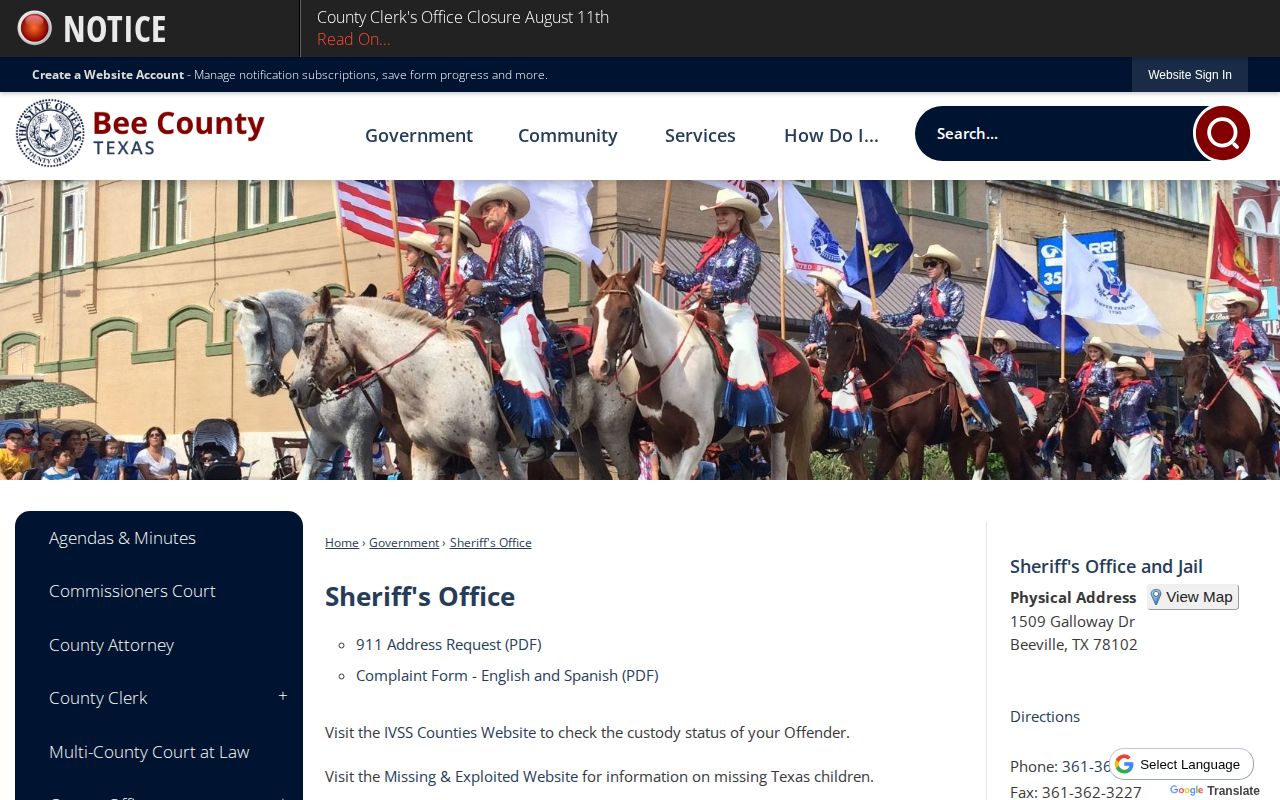
That source supports the records-and-status fallback. It does not support publishing a reconstructed list from unverified sites.
Why Missing Bee Results Are Weak
Section 19's distinctive Bee County angle centers on a sharp evidence problem: no official 24-hour or 72-hour feed exists, and the county-provided IVSS route warns that former detainees may drop out. A missing person is therefore unusually weak evidence of release. The absence might also reflect transfer, system lag, spelling, or an identity mismatch.
Build confirmation from records that affirm an event. The Sheriff's release time and terminal code are strongest for a county-jail exit. A matching IVSS released status and court order provide useful corroboration. A court order alone proves authority or case outcome, not physical departure. If the terminal record indicates transfer, confirm with the receiving agency.
The three-day range helps organize those checks. It does not change their weight. Record when each source was viewed, preserve the exact identifiers, and prefer the agency that owns the event when two sources conflict.
For state custody, a TDCJ release or discharge certificate and official incarceration history carry more weight than a projected date. BPP approval, parole eligibility, and a scheduled date are prospective. Even a scheduled date can change during processing. For federal custody, a BOP “RELEASED” result applies to BOP custody, not every USMS detainee or later supervision. Each statement must stay within the scope of its source.
Reconciling Bee Court Events
Three days can contain several legal events for one booking. Bee County misdemeanor and county matters may involve the County Clerk, while felony matters route through the District Clerk. The Multi-County Court at Law is another local route. Search by case number when possible and compare the bond, dismissal, judgment, sentence, jail-credit, or probation entry with the Sheriff's release record.
Do not confuse the County Clerk portal's “Last 24 Hours” or “Last 3 Days” filters with jail releases. Research found that those filters concern recorded documents. They do not produce an inmate-release list. A similarly named date filter is not interchangeable across systems.
The County Clerk's criminal department can help with misdemeanor and county-case dispositions. The District Clerk is the felony-record route, and the county's older direct link has not always remained available. If an online court endpoint fails, use the current county government page and clerk contact rather than concluding that the record does not exist. The court record explains legal authority, while the jail record proves execution.
A narrow three-day request can also ask for destination or receiving-agency fields where they exist. That one field often resolves the difference between “left Bee County custody” and “returned to the community.” If the Sheriff record does not include a destination, do not fill the gap from rumor or social media. Ask the plausible receiving system with the same identity details and date range.
Note: Ask whether the three-day report uses event time, entry time, or another agency reporting convention.