
McConnell Regional Release Site
The official McConnell Unit directory lists “Regional Release Site” under Additional Operations. That phrase describes a TDCJ processing role. It does not turn McConnell into the Bee County Jail, and it does not make Bee County the records custodian for people who physically exit there.
A regional site can process releases for state prisoners whose convictions, homes, or prior units are elsewhere. The reverse is also true. Someone from Bee County may receive a scheduled release location outside the county. Geography does not decide which agency owns the event. TDCJ creates and maintains the state release, discharge, and incarceration history.
The official directory capture below preserves the Regional Release Site designation. It is useful for explaining the site’s function, while a person-specific status or record is still required to prove any named release.
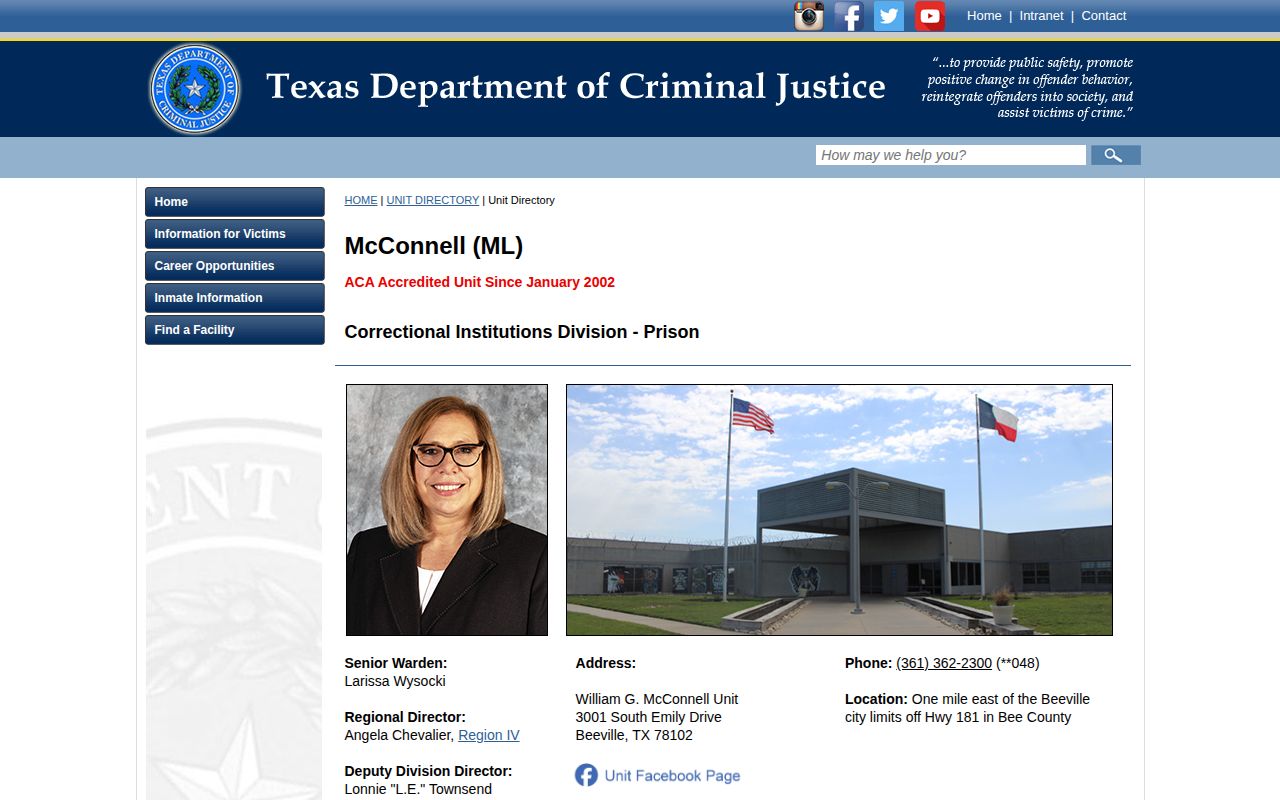
The directory identifies an operation, not a release list. Search the named person through TDCJ and compare identifiers before drawing a conclusion.
McConnell Release Outcomes
A completed McConnell exit can lead to parole, mandatory supervision, discharge, or another authority’s custody. Parole means institutional custody has ended under conditions set through the Texas parole process, with TDCJ Parole Division supervision. Mandatory supervision is a separate supervised-release framework. Discharge records completion of the applicable sentence or supervision obligation unless another matter remains.
Not every departure is a community release. A move to another TDCJ unit remains imprisonment. A warrant or detainer can produce a transfer. Even at a Regional Release Site, the final record must say what happened and which agency, if any, received the person.
| McConnell event | Custody result | Official route |
|---|---|---|
| Parole | Outside prison under state supervision | TDCJ IVSS and Parole Division |
| Mandatory supervision | Conditional release under Texas rules | TDCJ status and release certificate |
| Discharge | State sentence or supervision completed | TDCJ incarceration history |
| Transfer | Custody continues elsewhere | TDCJ or receiving-agency intake |
Confirm McConnell Unit Release
Use the TDCJ Online Inmate Search for a person who may still be incarcerated. A TDCJ number or SID is the best starting point. For a name search, enter the exact last name and at least a first initial. Open the detail and verify the person by number, conviction county, court, offense, and sentence.
The locator shows current TDCJ inmates, so its absence is weak evidence for a past release. A person may have discharged, changed systems, or simply not match the submitted data. TDCJ IVSS carries a more release-oriented record, including offender status, facility, expected or actual release date, and intake or release rows.
- Gather the full name, date of birth, TDCJ number or SID, and conviction county.
- Search current TDCJ custody and check whether McConnell is the current unit or scheduled site.
- Open TDCJ IVSS, verify the same identifiers, and read the release history.
- Ask Review and Release Processing about an approved case that has not reached a confirmed exit.
- Request the release certificate or incarceration history for a durable state record.
McConnell Release Processing
Texas parole decisions are made by the Board of Pardons and Paroles through file review. A favorable vote can include conditions, future dates, or program requirements. It is a decision in the release pathway, not proof that the person left McConnell. TDCJ must complete the legal and administrative audit.
Release processing can review sentence calculations, credits, warrants, detainers, release-plan details, conditions, and required programs. A scheduled release date and location may appear after this work advances. TDCJ warns that a scheduled date can still change, including late in the process. That is why a planned McConnell exit should be checked again after the stated date.
For post-approval status, call Review and Release Processing at 512-406-5202. For general inmate location and information, use 936-295-6371 or 800-535-0283 from 8 a.m. to 5 p.m. on weekdays. Pre-vote parole review status has a separate line at 844-512-0461. Keeping those lanes separate helps avoid treating review, approval, scheduling, and actual release as one event.
McConnell Release Date Labels
The projected release date is TDCJ Classification and Records’ present estimate if parole does not occur sooner. Parole eligibility is the point at which a qualifying person may be reviewed. The maximum sentence date generally marks full-term expiration. These fields can appear together, but they do not answer the same question.
Good-conduct time, disciplinary forfeiture, changed sentences, additional cases, detainers, Board decisions, required programs, and calculation audits can alter a projection. Texas does not use a universal “85 percent” rule. Offense type, offense date, and the governing statutes matter. Eligibility opens a review path and does not create a right to release.
- Projected date
- A changeable estimate calculated from the state sentence.
- Eligibility date
- The first review point for a qualifying case.
- Scheduled date
- A planned release after more processing, still subject to change.
- Actual date
- The completed event in TDCJ release status or records.
Request McConnell Release Records
TDCJ’s inmate information email channel can supply basic official information at no charge. Send the full name and seven-digit TDCJ number to pia@tdcj.texas.gov. If the number is not known, include exact date of birth or approximate age and county of conviction. Available items may include the TDCJ number, location, conviction and incarceration history, current offense and court, and projected release information.
For a release certificate, discharge record, or defined history, use the TDCJ Office of General Counsel request process. Requests can go to PIA@tdcj.texas.gov or TDCJ Public Information Request, PO Box 4017, Huntsville, TX 77342. Specify the person, time period, McConnell connection, and record fields sought. A request for the terminal release event, type, date, scheduled location, and destination is clearer than a broad request for all information.
A release certificate or official incarceration history is the strongest evidence. TDCJ IVSS and Review and Release confirmation are strong operational sources. A Board vote, projection, or schedule is prospective. The Bee County Sheriff cannot provide the state-prison release record.
McConnell Unit Record Facts
TDCJ lists William G. McConnell Unit at 3001 South Emily Drive in Beeville, with a main phone number of 361-362-2300. The directory gives an establishment date in September 1992 and a capacity of 2,956. It lists male custody levels G1 through G5, security detention, safekeeping, and transient populations.
Capacity and custody classifications describe the institution. They do not disclose who was released or when. The Regional Release Site line is similarly operational. A named person’s completed event must be found in the individual state record.
William G. McConnell Unit (ML)3001 South Emily Drive
Beeville, TX 78102
361-362-2300
Call the unit for current facility routing. Call before travel because the research did not establish public records-counter hours. Formal release documents should still be requested from TDCJ’s statewide custodian.
Bee County Release Custodians
“Released in Bee County” can refer to two separate systems. Bee County Jail records a local booking release or transfer. McConnell can process a statewide TDCJ release at its Regional Release Site. The first event belongs to the Sheriff’s custody record. The second belongs to TDCJ.
Garza West’s intake and transient work adds another source of confusion. A person may arrive in Bee County for state classification, move to another unit, and never receive a community release here. McConnell’s release role also means a person may physically leave in the county without having any Bee County court case.
Start with the last legal custodian, not the nearest building. The Bee County released-inmate lookup separates county, TDCJ, federal, and immigration routes. On a McConnell question, use the TDCJ branch unless an official record names a receiving authority.
McConnell Release Detainers
A release from TDCJ custody can coincide with transfer to another authority. A detainer is a request concerning notice or custody when the holding agency would otherwise release the person. It signals a possible handoff but does not prove that the receiving agency completed intake.
When the McConnell release record names ICE, check the ICE Online Detainee Locator System and the relevant ERO office. A no-result is not conclusive because the locator has coverage and timing limits. For a federal transfer, the federal docket, USMS records, or BOP locator may be the correct next source.
No reliable official source reviewed established a current Bee County ICE contract or dedicated federal facility. Historical references to government boarders do not prove a present arrangement. Confirm the exact terminal record and then the receiving agency’s event.
Verify McConnell Release Proof
When sources disagree, prefer the agency that owns the release, the dated or certified document, and the identifier-specific record. Do not silently combine similar names. Record the search date because current status can change.
A current TDCJ result proves state custody at the time shown. A current-search absence does not prove historical release. An IVSS released status offers strong state-system evidence, while the release certificate or incarceration history gives the most durable proof. A parole approval or scheduled date remains one step short of completion.
These distinctions matter most at a Regional Release Site. The gate location is locally visible, but the legal event remains statewide. Confirm the completed TDCJ release type, date, and any supervision or receiving authority before treating the person as returned to the community.