
Bee County Same-Day Release Records
The Bee County Sheriff's official page links IVSS Counties for offender custody status, but it does not link a roster titled recent releases, 24-hour releases, or booking photos. That distinction matters. IVSS is designed for a named-person status check and notification, not for browsing a certified list of everyone who left during a day. A real same-day release record is an event maintained by the Sheriff's Office.
A useful event record identifies the booking and states what ended county custody. It may reflect bond, personal bond, dismissal, time served, sentence completion, probation, or a transfer. Only some of those events return a person to the community. A transfer to TDCJ, another county, federal custody, or immigration custody also ends the Bee County jail stay, but it is not a community release.
Do not treat disappearance from IVSS as release. Confirm the terminal event, its time, and whether another agency received the person.
Check Bee County's Last 24 Hours
Use a fixed start and end time. “Today” can mean calendar day, the prior 24 clock hours, or a jail reporting day. A narrow request avoids that uncertainty and makes it easier for the records custodian to locate an existing transaction.
- For one known person, open Texas IVSS Counties, select Bee County, and compare the name with reliable identifiers.
- Read the status as a lead. If it shows released or out of custody, note when the status was observed.
- Call Bee County Jail at 361-362-3221 and ask whether the person was released or transferred during the precise interval.
- If a browseable day list is needed, submit a Texas Public Information Act request for existing release transactions from the stated start timestamp through the stated end timestamp.
- Match the jail event to the court order or receiving agency when the release type is unclear.
The Bee County released-inmate search gives the broader named-person path across jail, court, TDCJ, federal, and ICE systems. The 24-hour task stays focused on a single interval and the local event ledger.
Bee County Release Fields to Request
Because there is no official online Bee County 24-hour list, these are fields to request from the Sheriff's existing booking and release transaction. They are not promised IVSS display fields. Ask only for what is needed, since sealed, juvenile, medical, security, and other protected information may be withheld.
| Field | What it establishes |
|---|---|
| Name and booking number | Connects the event to the correct jail stay. |
| Admission date and time | Distinguishes the booking from another case. |
| Release date and time | Places the terminal event inside or outside the requested day. |
| Release type | Shows bond, time served, dismissal, sentence completion, or another coded basis. |
| Releasing authority | Identifies the court or agency behind the event. |
| Destination or transfer notation | Separates community release from handoff to another custodian. |
A court order can explain why release was authorized, yet it does not prove the moment jail staff completed the exit. The jail timestamp is stronger proof of physical departure. When identities conflict, use the booking number, date of birth, case number, or other reliable identifier rather than relying on a common name.
Release type also controls the follow-up. A bond or personal bond should lead to the court case and bond order. Time served or sentence completion should align with the judgment and jail-credit calculation. Probation means the court imposed community supervision, which is different from state parole. A transfer code should identify the next custodian whenever the existing record contains that information. Asking for these fields together prevents a bare timestamp from being misread.
No Bee County Release Feed
The absence of a Sheriff-published feed changes the workflow. For immediate personal notice about one county detainee, use IVSS Counties and complete the contact verification steps offered by the live portal. For durable proof, request the underlying jail record. For a court basis, consult the County Clerk for misdemeanor and county matters or the District Clerk for felonies. These sources answer different parts of the question.
A person sent to a Texas prison belongs in TDCJ systems after the county handoff. The current TDCJ Inmate Search is chiefly for people still in state custody, while TDCJ IVSS or an incarceration-history request is more useful for release and discharge history. The Bee County 72-hour release route explains how to request a wider three-day range.
The source image below is the Sheriff page that documents the IVSS route and the lack of a linked recent-release list. Review the official Bee County Sheriff page for its current contact and custody link.
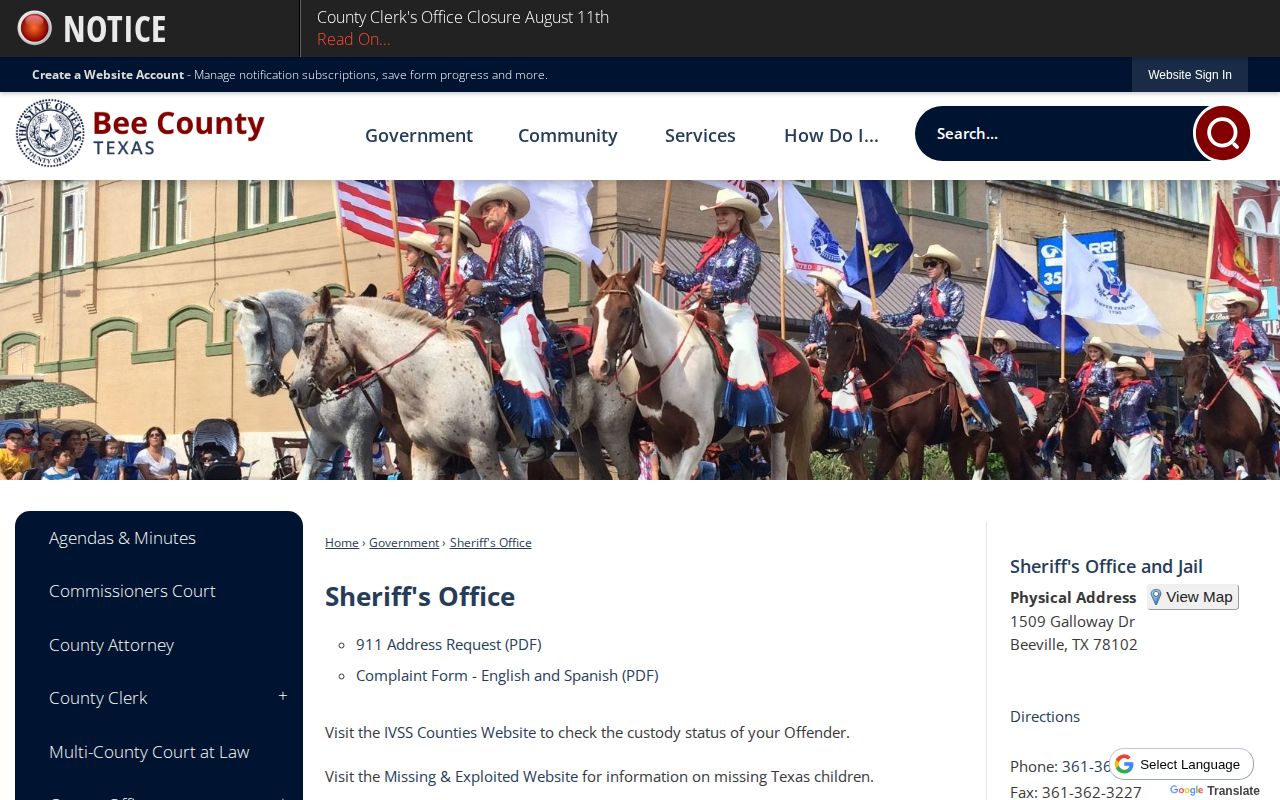
The page directs a named custody check to IVSS, so it should not be represented as a public same-day release ledger.
A public-information request should seek records that already exist. Give a full name, aliases, date of birth, booking number if known, and the exact 24-hour interval. Ask for electronic copies of the release transaction and related booking fields. The Texas Attorney General publishes statewide cost rules, but research found no fixed Bee County photo or same-day report fee. Let the custodian provide a lawful estimate rather than assuming a price.
Bee County Release or Transfer
Still in custody means Bee County continues to hold the person. Released means that particular county confinement ended, but the destination controls what the event means next. Bond, dismissal, time served, sentence completion, or probation may return someone to the community. A detainer or commitment may instead cause an immediate handoff.
| Observed fact | Best next check |
|---|---|
| IVSS shows county custody | Confirm with the jail if an exit is expected. |
| IVSS shows released | Obtain the Sheriff's release type and timestamp. |
| Name disappears | Rule out transfer, data interruption, and identity mismatch. |
| County record shows TDCJ transfer | Use the statewide TDCJ number and status. |
| Record suggests ICE handoff | Check ICE ODLS or ERO; a no-result is inconclusive. |
A current roster is not an archive. A former detainee may no longer appear, and IVSS itself says portal data is not an official record. Keep the observed status, then obtain the event from the agency that created it.
Federal and immigration systems require another distinction. A person housed locally on federal authority may never enter BOP's sentenced-prison population. USMS and the federal court control many pretrial movements. An ICE detainer is a request for notice and possible handoff, not proof that ICE actually assumed custody. The county terminal record should show the local event first; BOP, USMS, or ICE can then address the next phase.
Why Missing IVSS Results Prove Little
Bee County's unusual release-list problem is not just the lack of a browseable feed. The Sheriff routes custody checks to IVSS Counties, while IVSS warns that former detainees may be absent. Thus the very system available online becomes less useful after the event a reader is trying to prove.
Use the county IVSS portal as a status and notification lead. Then seek the booking and release transaction or a matching court or receiving-agency record. A matching court order is helpful, but the jail's timestamp and terminal code remain the best local proof of physical release. Save the exact interval and identity data used in each inquiry.
Notification registration can help with future changes. The current county system uses live account or contact-confirmation steps presented by IVSS Counties. Do not follow old Texas VINE instructions that depend on a four-digit telephone PIN. County notification transitioned to IVSS Counties, and the legacy workflow no longer describes the current Bee County process. Even a timely alert should be paired with the official event when proof is required.
Bee County App and Social Limits
Bee County promotes a general public-information app and the Sheriff maintains a social presence. No official source reviewed confirms that either offers an inmate lookup, same-day release feed, or mugshot archive. A civic app must not be relabeled as a jail app merely because it bears the county name.
Social posts are selective news. They may describe an arrest, public-safety event, or agency activity, but silence says nothing about release. A post can also predate court action by days or months. Treat it as a lead and verify the exact booking through IVSS, the Sheriff's record, and the relevant court. This distinction is the Section 19 app-and-social angle assigned to the Bee County 24-hour page.
Note: Request the exact calendar date and time zone when asking for one day of release transactions.